
Why Does Your Weight Fluctuate So Much Day to Day?

7 min read
If you’re trying to lose weight, few things are more frustrating than stepping on the scale and seeing your weight jump up overnight.
You followed your plan. You trained. You tracked your food.
Then somehow you’re 2 or 3 pounds heavier the next morning.
The important thing to understand is this:
A short-term increase on the scale does not automatically mean you gained body fat.
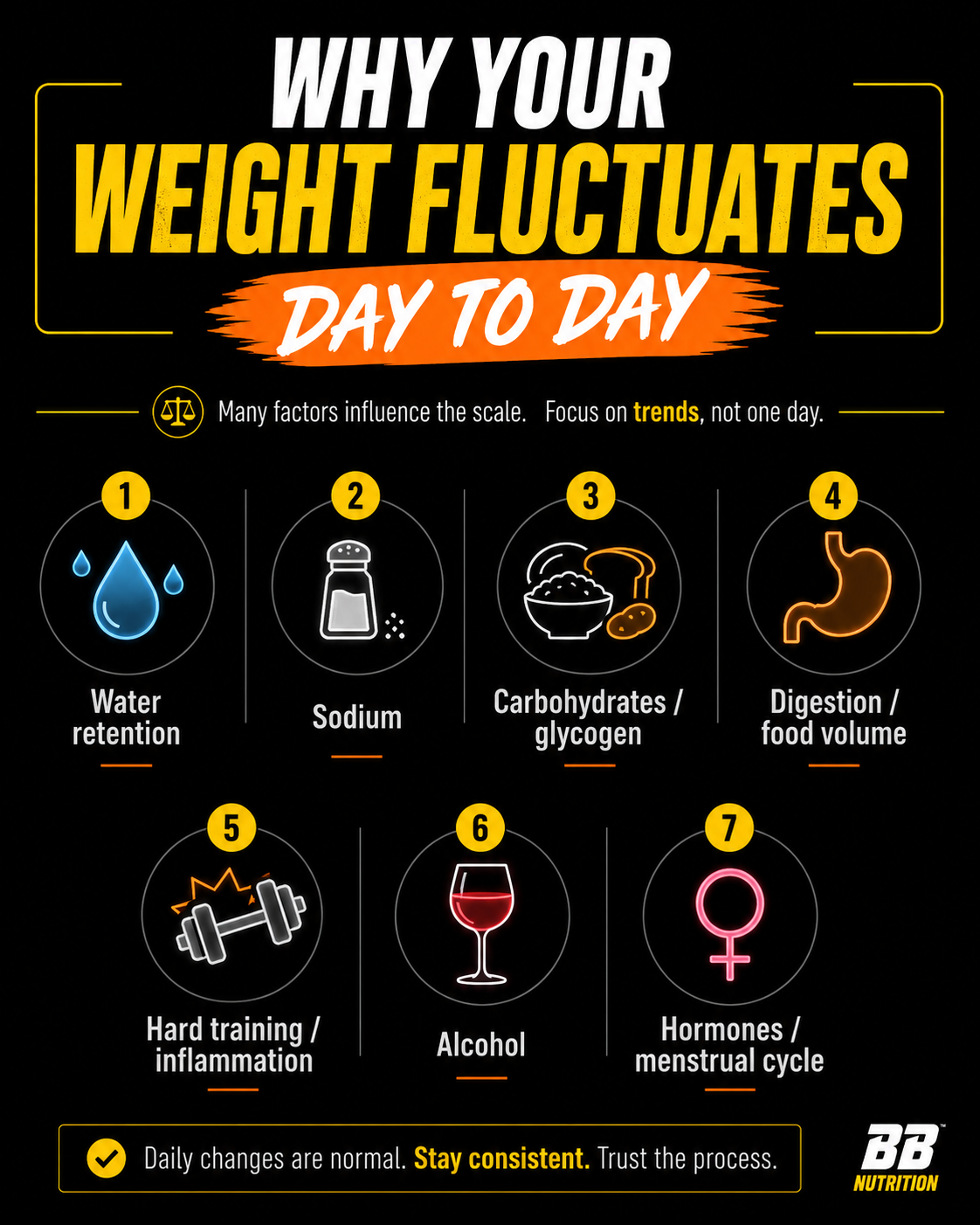
Your body weight can change from day to day because of water, sodium, carbohydrates, digestion, training, hormones, alcohol, and several other factors.
That’s why looking at your overall weight trend is much more useful than reacting to a single weigh-in.
1. Water Retention Can Move the Scale Quickly
Your body is constantly adjusting how much water it holds.
That alone can cause noticeable changes in scale weight without any meaningful change in body fat.
You may temporarily retain more water because of:
Higher sodium intake
More carbohydrates
Hard training
Poor sleep
Stress
Hormonal changes
Alcohol
Changes in hydration
This is why you can wake up several pounds heavier after a restaurant meal or weekend away even if you didn’t suddenly gain several pounds of fat.
The scale measures everything in your body, not just body fat.
2. Sodium Can Increase Water Retention
A higher-sodium meal can cause your body to temporarily hold additional water.
This is especially noticeable after things like:
Restaurant meals
Takeout
Pizza
Fast food
Sauces and condiments
Processed foods
That doesn’t mean sodium is “bad.”
It simply means your scale weight may temporarily rise after eating significantly more sodium than you normally do.
This is one reason weighing yourself after a night out and immediately deciding your diet “isn’t working” can be misleading.
Your weight may return closer to normal over the following few days once your intake and hydration return to your normal routine.
3. Eating More Carbohydrates Can Increase Scale Weight
Carbohydrates are stored in your muscles and liver as glycogen.
When glycogen is stored, water is stored along with it.
So if you normally eat relatively low carbohydrates and then have a higher-carb day, your scale weight may increase even if your body fat hasn’t meaningfully changed.
The reverse can happen too.
When people suddenly reduce carbohydrates, they often see a quick drop in body weight during the first several days.
Some of that early change is water and glycogen rather than pure body-fat loss.
This is why fast changes on the scale don’t always tell you exactly what is happening with body fat.
4. Food Still Being Digested Has Weight
This one gets overlooked constantly.
The food and fluids inside your digestive system contribute to your total body weight.
If you eat:
A larger dinner than usual
More fibre
More total food volume
A late-night meal
More fluids
you may simply have more physical mass sitting inside your digestive system when you weigh yourself the next morning.
That doesn’t mean the meal immediately became body fat.
It means food has weight before your body even finishes digesting it.
Bathroom habits can also affect what you see on the scale.
This is another reason comparing individual weigh-ins can be misleading.
5. Hard Training Can Temporarily Increase Your Weight
Exercise is obviously beneficial for weight loss and overall health, but hard training can temporarily affect the scale.
When you perform strenuous exercise—especially resistance training or a workout your body isn’t accustomed to—you create small amounts of muscle damage and inflammation.
As part of the recovery process, your body may temporarily hold additional fluid.
So it’s completely possible to:
train hard → be making progress → wake up heavier
That doesn’t mean the workout made you gain fat.
It can simply be part of the recovery process.
For people training several times per week, this is another reason the scale should be viewed as one piece of information rather than the entire picture.
6. Alcohol Can Affect Your Weight in Both Directions
Alcohol can make scale weight particularly unpredictable.
Initially, alcohol can increase urine production and contribute to dehydration.
That can sometimes make your weight temporarily appear lower.
But a night of drinking often comes with:
Higher sodium intake
More carbohydrates
Larger meals
Restaurant food
Poorer sleep
Changes in hydration
So the following day—or even the day after that—you may see your weight increase.
Again, that doesn’t mean every pound gained on the scale represents a pound of body fat.
It’s usually a combination of food volume, fluid balance, glycogen, and whatever additional calories were consumed.
7. The Menstrual Cycle Can Affect Scale Weight
For women who menstruate, hormonal changes throughout the menstrual cycle can cause temporary water retention and bloating.
Premenstrual water retention is common, and hormonal changes are thought to be one of the main reasons it occurs. Mayo Clinic also notes that higher salt intake can make water retention worse during this time.
That means someone can be following their nutrition plan extremely well and still see their weight temporarily increase around certain phases of their cycle.
This is why comparing weight across similar points in the menstrual cycle can sometimes give you better context than comparing random days.
If you notice the same pattern occurring every month, it may simply be part of your normal cycle rather than a sign that your plan has stopped working.
Why One Weigh-In Doesn't Tell You Much
Imagine your weight looks like this:
Monday: 180.2 lb
Tuesday: 179.6 lb
Wednesday: 181.1 lb
Thursday: 180.4 lb
Friday: 179.8 lb
Saturday: 180.0 lb
Sunday: 179.3 lb
If you only compared Tuesday to Wednesday, you might think:
“I gained 1.5 pounds.”
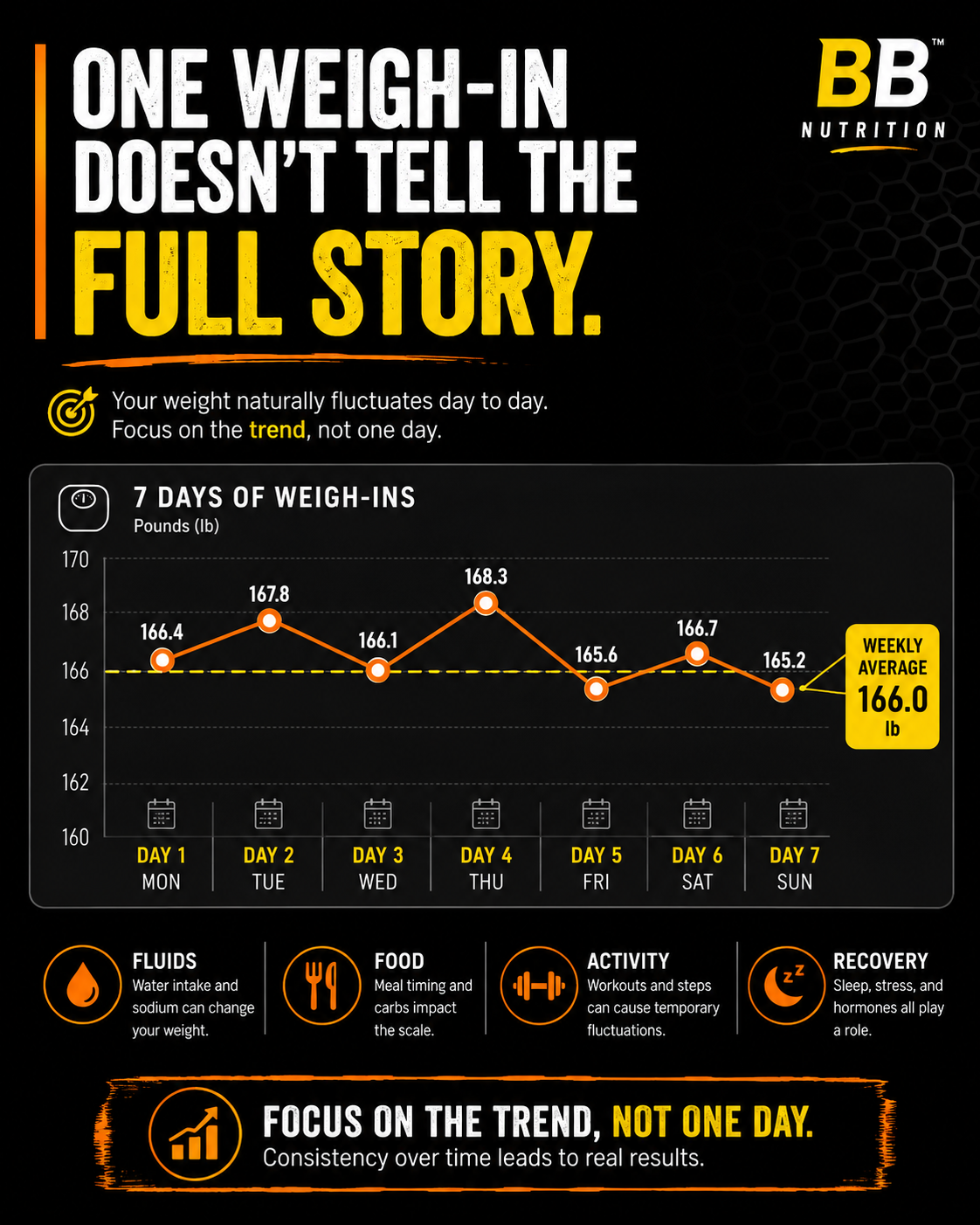
But when you look at the entire week, you get a much clearer picture of what is actually happening.
Body weight is noisy.
The trend is what matters.
Use Weekly Average Weight Instead
One of the simplest ways to reduce the confusion is to weigh yourself under similar conditions and look at your weekly average.
Ideally:
Weigh yourself in the morning
After using the bathroom
Before eating or drinking
Under similar conditions each day
Then calculate the average.
Compare that average to previous weeks rather than obsessing over individual days.
This helps smooth out the noise caused by water, sodium, carbohydrates, digestion, and other temporary factors.
Don’t Slash Your Calories Because of One Bad Weigh-In
This is one of the biggest mistakes I see.
Someone wakes up 2 pounds heavier and immediately thinks:
“I need to eat less.”
So they cut another 300 or 500 calories.
But nothing was actually wrong with their calorie intake.
Their weight simply fluctuated.
Before changing your calories, look at your trend over at least a couple of weeks and ask:
Has my average weight actually stopped decreasing?
Have I been consistent with my food intake?
Has my activity changed?
Have I eaten more restaurant meals?
Has my sodium or carbohydrate intake changed?
Have I trained harder than usual?
Am I comparing similar conditions?
If you’re unsure how to determine an appropriate starting calorie intake, read How Many Calories Should You Eat to Lose Weight?
And if your average weight truly hasn’t moved for several weeks, read Why You’re Not Losing Weight Anymore — And What to Do About It.
The Scale Is Useful — Just Don’t Let It Control the Plan
Daily weighing can be very useful because it gives you more data.
The problem isn’t the scale.
The problem is reacting emotionally to every individual number.
Think of daily weigh-ins as data points.
One number doesn’t tell you much.
A collection of numbers over several weeks tells you far more.
That’s why I prefer looking at:
Weekly average weight
Waist measurements
Progress photos
Training performance
Energy
Hunger
How consistently the nutrition plan is being followed
The more information you have, the less likely you are to make unnecessary changes based on one weird morning.

Final Thoughts
Your body weight is supposed to fluctuate.
Water retention, sodium, carbohydrates, digestion, training, alcohol, and hormonal changes can all move the scale without representing a meaningful change in body fat.
So if your weight jumps overnight, don’t panic.
Don’t immediately cut calories.
And don’t assume your progress has stopped.
Instead:
Keep your weigh-ins consistent.
Look at your weekly average.
Give the trend enough time to become clear.
Make adjustments based on several weeks of data—not one day.
The scale is one tool. The trend is what tells the story.
If you’re struggling to make sense of your weight fluctuations or figure out when your nutrition actually needs adjusting, personalized nutrition coaching can help simplify the process.
