
How many calories should you eat to lose weight?

6 min read
When it comes to weight loss, one of the most common questions is:
“How many calories should I actually be eating?”
The problem is that there isn’t one calorie target that works for everyone.
Your body weight, activity level, muscle mass, daily movement, training schedule, and metabolism all affect how many calories you burn.
That means the goal isn’t to find a magical number.
The goal is to find a reasonable starting point, track how your body responds, and make adjustments from there.
Step 1: Estimate Your Maintenance Calories
Maintenance calories are roughly the number of calories you need to eat to maintain your current body weight.
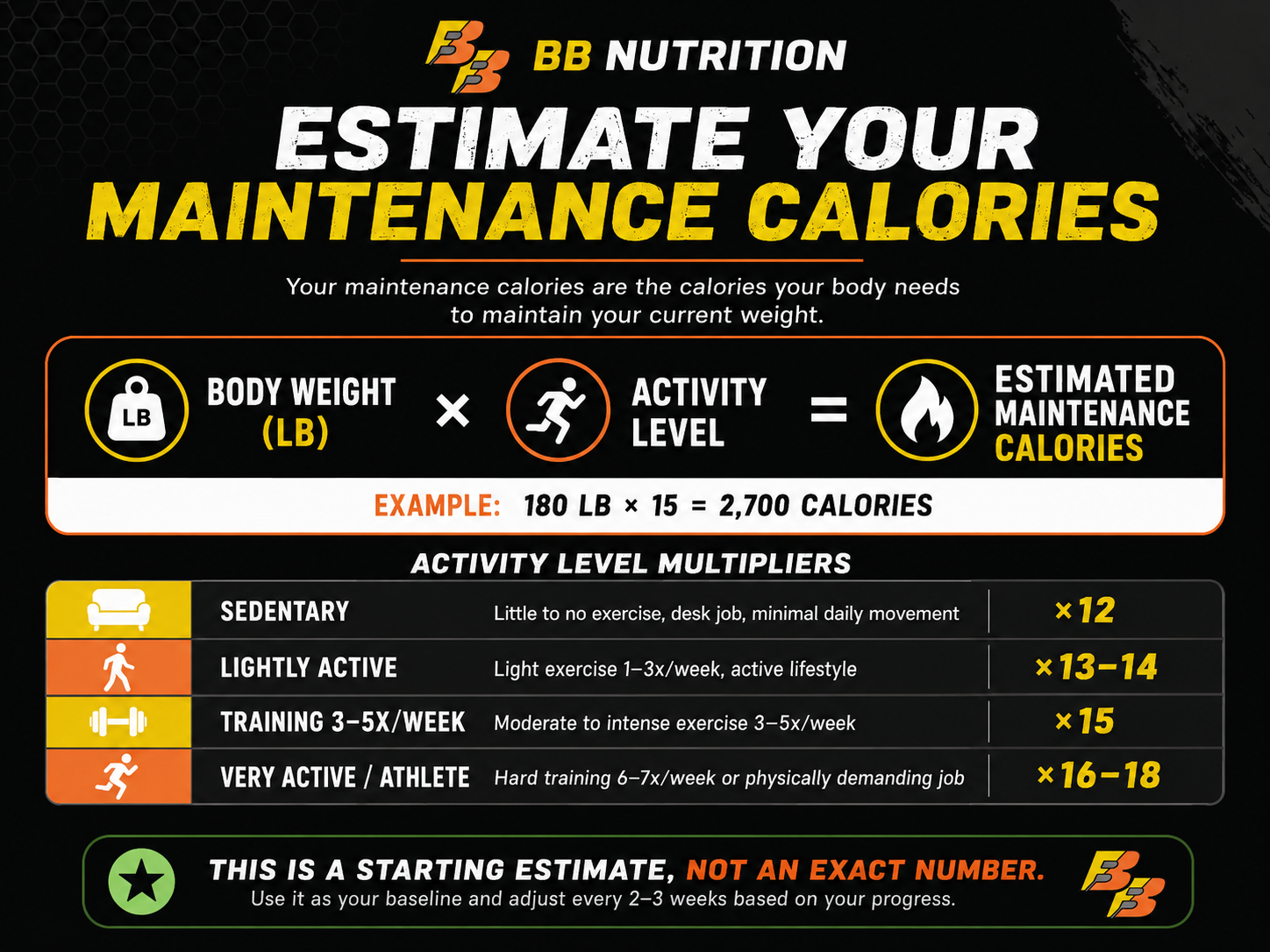
A simple way to estimate this is to take your body weight in pounds and multiply it by an activity factor.
Simple Maintenance Calorie Estimate
Sedentary:
Body weight × 12
Lightly active:
Body weight × 13–14
Training 3–5 times per week:
Body weight × 15
Very active / athlete:
Body weight × 16–18
This isn’t designed to give you a perfectly precise number.
It gives you a practical starting estimate that can then be adjusted based on your real-world results.
Step 2: Choose an Activity Level That Actually Matches Your Lifestyle
This part matters more than people realize.
Just because you go to the gym four times per week doesn’t automatically mean you have a very high daily calorie expenditure.
There can be a big difference between:
Someone who trains four times per week but works at a desk and averages 3,000–4,000 steps per day
Someone who trains four times per week, works a physical job, and averages 12,000 steps per day
Both people exercise regularly, but their total daily energy expenditure may be very different.
When choosing your multiplier, think about your entire day, not just your workouts.
Consider your:
Training frequency
Daily step count
Job activity
Recreational activity
Overall movement throughout the week
When in doubt, it’s usually better to start slightly more conservatively and adjust from there.
Step 3: Create a Reasonable Calorie Deficit
Once you have an estimate of your maintenance calories, you need to create a calorie deficit for weight loss.
That simply means eating fewer calories than your body is using.
For many people, a reasonable starting point may be around a:
200–400 calorie daily deficit
The exact number will depend on your body size, activity level, goals, hunger, training demands, and how quickly you’re trying to lose weight.
A smaller deficit can often make dieting easier to maintain because you have more calories available for food, training, recovery, and social situations.
Example
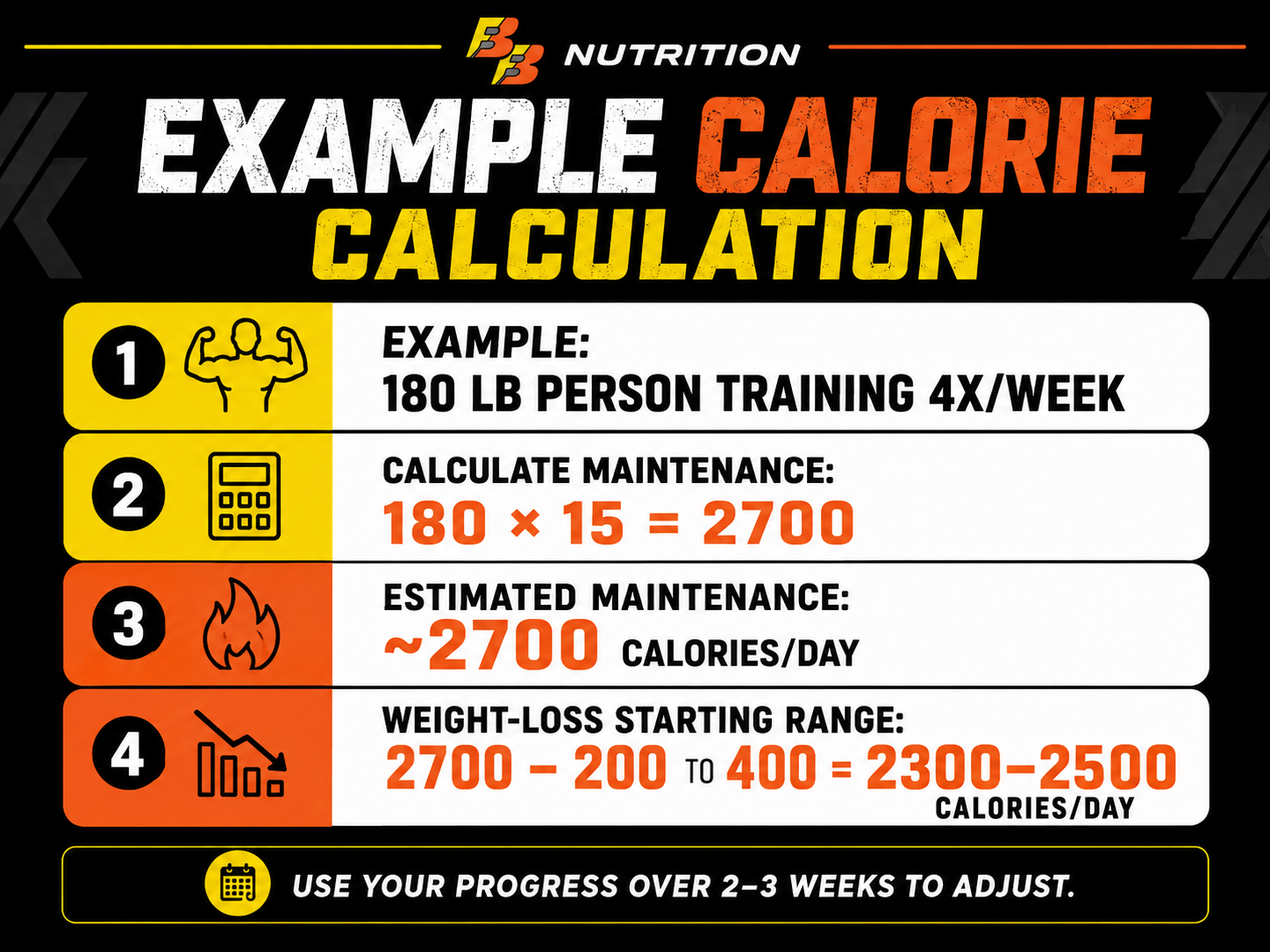
Let’s say you weigh 180 lb and train around four times per week.
Using a multiplier of 15:
180 × 15 = 2,700 calories
Your estimated maintenance intake would be approximately:
2,700 calories per day
From there, you could start with a moderate deficit:
2,700 − 200 to 400 calories
That would give you a starting calorie target of roughly:
2,300–2,500 calories per day
Notice the word starting.
You’re not locked into that number forever.
Step 4: Understand That This Is Only an Estimate
Calorie calculators and body-weight formulas are useful, but they cannot know exactly how many calories your body burns.
Two people who weigh the same amount may have different calorie needs because of differences in:
Muscle mass
Metabolism
Daily steps
Training volume
Job activity
Sleep
Recovery
Genetics
Previous dieting history
That’s why the number you calculate on day one should be treated as an estimate.
The real answer comes from tracking what happens over the next few weeks.
Step 5: Track Your Progress Before Making Adjustments
Once you have your starting calorie target, give your body enough time to respond.
For most people, I’d recommend tracking consistently for around 2–3 weeks before making a major adjustment.
Look at more than just one weigh-in.
Pay attention to:
Your average body weight
Energy levels
Training performance
Hunger
Progress photos
Waist or body measurements
How consistently you’re following your plan
Daily scale weight can fluctuate because of water, sodium, carbohydrates, digestion, stress, training, and many other factors.
That’s why your average weight trend matters more than what the scale says on one particular morning.
If your average weight is gradually trending down, your calorie intake is probably doing its job.
If your average weight isn’t changing after a few weeks and you’ve been consistent, then it may be time for a small adjustment.

Don’t Cut Calories Too Aggressively
One of the biggest mistakes people make when trying to lose weight is immediately cutting calories as low as possible.
More restriction doesn’t automatically mean better results.
An overly aggressive deficit can make it harder to manage:
Hunger
Energy
Training performance
Recovery
Social eating
Long-term consistency
The goal should be to eat as much food as you reasonably can while still making progress.
If a 250-calorie deficit is producing results, there’s no reason to immediately create a 700-calorie deficit.
Make the smallest adjustment necessary to keep progress moving.
What If Your Weight Stops Dropping?
As you lose weight, your calorie needs may gradually decrease.
A lighter body generally requires less energy to maintain than a heavier body.
Daily movement can also change during a diet without you noticing.
This is one reason weight loss can slow down over time.
If progress stalls, don’t immediately panic.
First ask:
Have I been tracking consistently?
Have portions increased?
Are weekends different from weekdays?
Has my daily movement dropped?
Has my training changed?
Have I actually been stalled for several weeks, or is this just normal scale fluctuation?
This is where having accurate food and body-weight data becomes extremely useful.
If you want a deeper explanation, you can also read Why You’re Not Losing Weight Anymore — And What to Do About It.
Food Tracking Can Make This Much Easier
Once you have a calorie target, some form of food tracking can help you understand whether you’re actually eating close to that number.
That doesn’t mean everyone has to weigh every gram of food forever.
Tracking can be as detailed as using a nutrition app or as simple as keeping a food journal or taking photos of meals.
The purpose is awareness.
If you’re interested in learning more, read Why Tracking Your Food Intake Can Help With Weight Loss.
Final Thoughts
There is no perfect calorie calculator.
The best approach is to:
Estimate your maintenance calories
Create a reasonable calorie deficit
Track your progress
Give the plan enough time to work
Adjust based on what your body actually does
Your calorie target is not supposed to be perfect on day one.
It’s supposed to give you a starting point.
From there, your real-world progress tells you whether that number needs to stay the same, move slightly lower, or occasionally even move higher.
The goal isn’t to eat as little as possible.
The goal is to find an intake that allows you to lose weight while still having enough food to support your energy, training, recovery, and lifestyle.
Consistency over perfection.
If you’re struggling to figure out how many calories you should be eating or how to adjust your intake as your weight changes, personalized nutrition coaching can help take the guesswork out of the process.
